MAY EDITION • 2012
Raising the Bar: Relationship Building – R&B Music
by W. Blair Meeks
Communication Strategist
Jackson Spalding
You have probably heard this next piece of business advice a thousand times: success in business is all about relationships. It is definitely true. The trouble is, many times, that is as far as that piece of advice goes. Sure, relationships are how the vast majority of business decisions are made; they impact who is hired, who is fired, who wins clients and who earns important positions. But hearing this advice is a long way from knowing what it means or, more precisely, knowing how to put it into practice.
In this month’s Raising the Bar I’m going to explain the Jackson Spalding view on relationship building. We call it R&B Music (when it’s working well it is as smooth, flowing and comfortable as an old R&B groove) and my guru in this field is Glen Jackson, one of the founders of our firm.
Glen must be one of the most well-connected men in Atlanta. He knows people across the Metro and around the state. He is connected to the business community in every sphere across the wide spectrum that makes up our region. Of course, he didn’t start out this way; it took years of dedicated, consistent work. It is work that has resulted in a support system that helps drive opportunity and growth for our firm.
So how did he do it? He’ll tell you one meaningful, sincere relationship at a time. I’ll extend his lesson to bring up two areas of concentration: deeper connections and well-placed connections.
When I first started working at JS, I was really impressed when I found out about Glen’s little blue book. It’s a book he’s kept with him for years. In it is a long string of names, numbers, dates and personal information that together becomes a valuable lesson in relationship building. It’s a relationship ledger, and the goal of this balance sheet is more powerful business partnerships. When Glen meets someone, he does a number of things that are all focused on making a deeper, longer-lasting connection. Personal details are one of the keys. He’ll ask (when it feels natural) about family, schools attended, passions they may have for art or music, about a spouse or child, and after each meeting he pulls out his little blue book and makes an entry. He writes tips about the meeting and those personal details.
The book then goes in his briefcase ready for the next meeting with that person or group. When that meeting comes, he reviews his notes and he’s ready to build a connection that goes deeper. After a few meetings, he no longer needs the notes from his book because he’s internalized the connection. It’s become a relationship where true caring goes both ways. It’s not just a business opportunity; it’s a life-sharing opportunity . . . one that creates a sense of bonding that these two individuals have become a team that is taking on the challenges of business (or law) as one.
It takes discipline. It is not something you can fake and should never be forced. Glen’s book works for him because he is so sincere. He genuinely cares. Little things like remembering that your child went in for surgery may not seem like much by themselves, but string a few of those events together over time and it becomes the fabric of a powerful partnership. You look back after a few years and have a long list of ups and downs, shared triumphs and challenges. It is exactly those celebrations and struggles that make life worth living, and not just in the business world. It’s true of relationships and families too.
So that’s the deeper connections part. Well-placed connections involve a little more strategy, and we’ve boiled it down to a four-step process: assessment, identification, research and action.
1. Assessment – Take stock of who you are and where you are in terms of your business and law practice. Take a look at clients and identify similarities in who they are and how they came to be clients. If you continue to do the same things, you’ll get the same results.
2. Identification – Develop a list of the types of clients you realistically feel you should be adding to your client base. Are you missing anything? Are there skills not being utilized?
3. Research – Look into where the clients on that list are involved both in business and on a personal level. Are there groups they belong to? Social events they go to? Charities they support? Boards on which they participate? Professional societies of which they are members?
4. Action – Now put yourself in situations where you can interact with clients on that list in a normal, non-pitching or salesy kind of way. The goal is honest interaction. You want to learn about them and have them learn about you. If there are similarities, the business part will flow naturally as long as this relationship of trust begins on comfortable ground.
That’s what we mean when we say “well-placed connections.” They are connections in the areas where you are striving to be more involved. Feel too sneaky for you? Think about it this way: an important component of business or law practice success is involvement in your community. You can develop connections through the activities you normally do. That works. You can also add an extra step of strategy when choosing those activities.
Deeper connections and well-placed connections are keys to beautiful R&B music. When done well it’s as easy as sittin’ on the dock of the bay wastin’ time.
The Closing Letter
Adriana de la Torriente
Torriente Marum, LLC
www.torrientemarum.com
Sentences begin with a capital letter and end with a punctuation mark. A few months ago, I discussed sending clients a welcome letter at the start of representation to introduce them to your firm and set expectations. Think of the welcome letter as the capital letter at the beginning of a sentence and the closing letter as the punctuation mark. When you reach the punctuation mark, you know the author has completed their thought. Similarly, when a client receives your closing letter they understand that your representation is complete. Although the structure and content will vary from practice area to practice area and from client to client, you should consider covering the following in your closing letters:
Thank you for choosing our firm to represent you in this matter. Take the opportunity in the closing letter to thank the client for choosing your firm for representation. For example, “Thank you for choosing ABC Firm, LLC, to represent you in your automobile injury case.”
Our representation is complete upon entry of a final order. Your closing letter should make it clear that your representation is complete. One attorney I spoke to regarding closing letters stated that he always returns to the Representation Agreement when writing a closing letter. He explains in the letter: you hired our firm to do this, we did that, therefore our representation is complete. For example, “You hired us to represent you in a modification of child support. We had a final hearing on that matter on Tuesday, May 1, and your child support was modified to $X.”
Please find the enclosed final order in your matter. If you were engaged to represent the client in litigation, send the client a copy of the final order. In the letter, note any important elements in the order, particularly deadlines that will occur in the next 30 days. For example, in a child custody case, the non-custodial parent may have to elect visitation by April 15. If you are sending your closing letter on April 1, you may want to remind them of their election deadline. Likewise, if you were retained to draft a contract, you would send the client a copy of the contract and instruct them on the final procedures for executing the contract.
Should you need a professional to assist you with ____, please contact us. We can provide a referral. As attorneys, we interact with a wide variety of people in different professions. Use your network to provide a service to your client by referring them to people you trust. If your client just won a big settlement or is receiving alimony from a divorce, you may refer them to a competent financial planner. If your client just got divorced, you may want to recommend an attorney who can advise them on changing their will or a realtor who can help them sell their house.
We have documents in our file that you may want returned to you. Please call our office to make arrangements to pick them up. If your representation required you to send and receive discovery on behalf of your client, you may have boxes of documents taking up valuable space in your office. Remind the client to come by to pick up their documents and that you will destroy anything not picked up within a certain amount of time.
It was a pleasure working with you. If we can ever be of assistance again please do not hesitate to call. Thank the client while reminding them of your practice areas. In researching this article, a criminal defense attorney said that he sent a thank you letter to a client of his whom he represented in a criminal matter. In the letter, he included that he also practiced personal injury law and represented clients in automobile injury cases. The client immediately referred his mother who had recently suffered an injury. Also, you may want to include a business card. Happy clients are the best referral sources.
Continuing Legal Education – April 2012
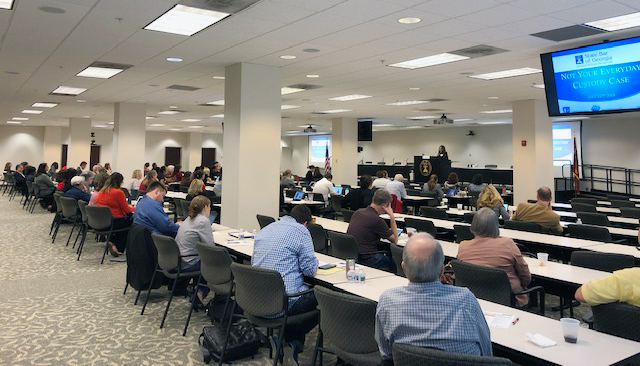
Attendees listen to our panel of experts at this month’s CLE event.
April Happy Hour Recap
April Luncheon Recap
Family Law Section: April 2012 Breakfast Recap